Click the ‘+’ icon to expand the menu
As you step into the church through the south door, the first thing you see is the Font. Its position is deliberate. Traditionally the font is placed near the entrance of a church to remind us that Christian life begins with baptism. Just as people enter the building through this doorway, they enter the Christian community through the waters of baptism.
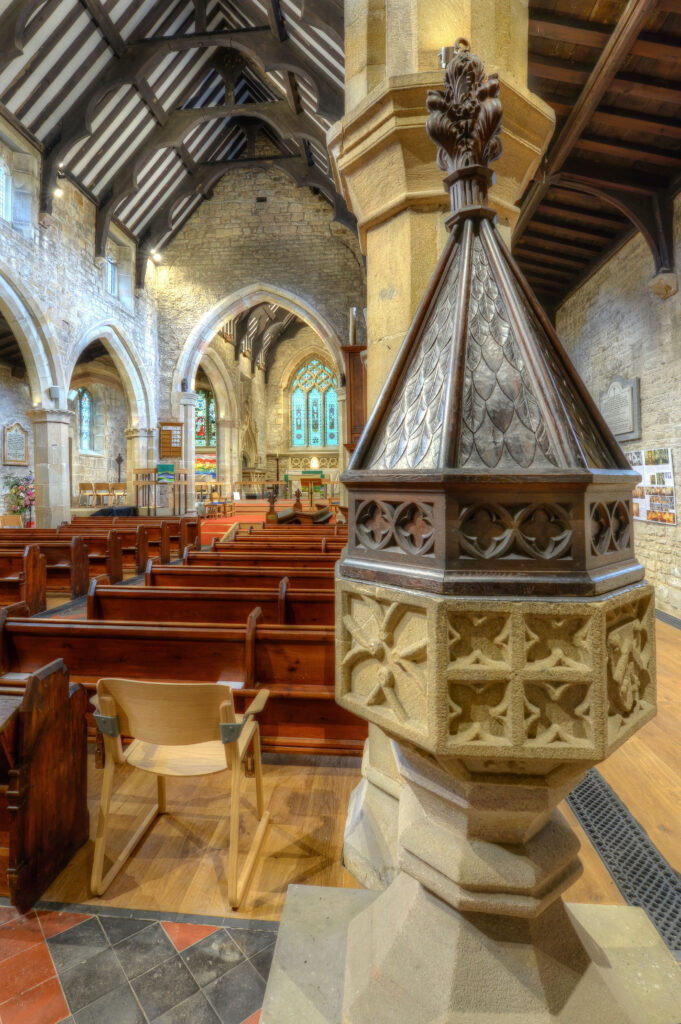
The font at Hathersage dates from the fifteenth century, a time of great rebuilding and renewal in the church under the Eyre family. It is octagonal in shape, which was a common design in medieval England. The number eight symbolised new beginnings and resurrection.
Around the bowl of the font are carved shields. Two of these display the arms of the Eyre and Padley families, both of whom played a major role in restoring and enlarging the church during the late medieval period. Their work gave the building much of the character you see today.
In centuries past, baptism was usually performed using water blessed at Easter. The font would often be kept locked to protect the holy water, and some churches even had canopies to safeguard it. Although those traditions have changed, the font remains a symbol of welcome, belonging and community.
Standing beside it, you are very close to where countless generations of local families have begun their spiritual life. Many people in Hathersage still have memories of baptisms held here, linking today’s community to the long history of the parish.
Look closely at the stonework. It has been touched, leaned on and admired by parishioners for more than five hundred years. The marks and textures you see connect the present day with medieval worshippers who would have gathered in the same place, beneath the same tower arch and clerestory windows.
The font is not simply an object of the past. It is still used regularly for baptisms today, continuing a tradition that has shaped the life of this church for centuries.
